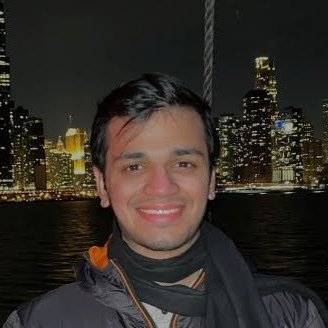
I am a graduate student at the Robotics Institute in Carnegie Mellon University's School of Computer Science, where I work with Prof. Nancy Pollard. Previously, I conducted vision research at the National Center for Supercomputing Applications with Prof. Narendra Ahuja and co-authored a paper at NeurIPS 2025. My interests span robot learning (world models, imitation learning, contact-rich manipulation), computer vision (3D perception, neural rendering), and robotics systems (simulation, teleoperation, CUDA). In industry, I have built autonomy and embedded-systems infrastructure at Rivian and Volkswagen Group Technologies and agentic AI systems at AstraZeneca.
News
- Aug 2026 Started graduate study at Carnegie Mellon University's Robotics Institute, working with Prof. Nancy Pollard
- Jun 2026 Joined Rivian and Volkswagen Group Technologies as an Embedded Systems Software Intern, building validation infrastructure for telemetry from autonomy and infotainment ECUs
- Sep 2025 Paper accepted at NeurIPS 2025: "Toward Engineering AGI: Benchmarking the Engineering Design Capabilities of LLMs"
- May 2025 Started as ML Intern at AstraZeneca, built RAG agents for large-scale pharma data access
- Jan 2025 Started as Computer Vision Researcher at NCSA and CSL with Prof. Narendra Ahuja, refractive turbulence restoration with physics-informed deep learning
- 2024 Awarded the Samsung Engineering Scholarship, Illinois Outstanding Scholarship, Illinois Engineering Achievement Scholarship, and Compall Family Scholarship
Publications
Proceedings of the 39th Conference on Neural Information Processing Systems (NeurIPS 2025)
Undergraduate Thesis, Department of Electrical and Computer Engineering, UIUC
Research Projects
Robot Learning
- Trained an action-conditioned latent flow-matching world model on 0.5B frames of human egocentric and simulated robot video to jointly predict future visual states and actions, learning a generative model of embodied dynamics rather than a deterministic next-frame predictor.
- Formulated representation learning through the evidence lower bound (ELBO), balancing reconstruction likelihood against KL divergence to a latent prior; learned conditional probability paths with flow matching so the model could represent multiple plausible futures in a compact latent space.
- Factorized long-horizon prediction into causal history modeling and DiT-style latent flow generation, then reparameterized transitions as latent deltas between consecutive frames so the model focused on state change and accumulated less drift during autoregressive rollouts.
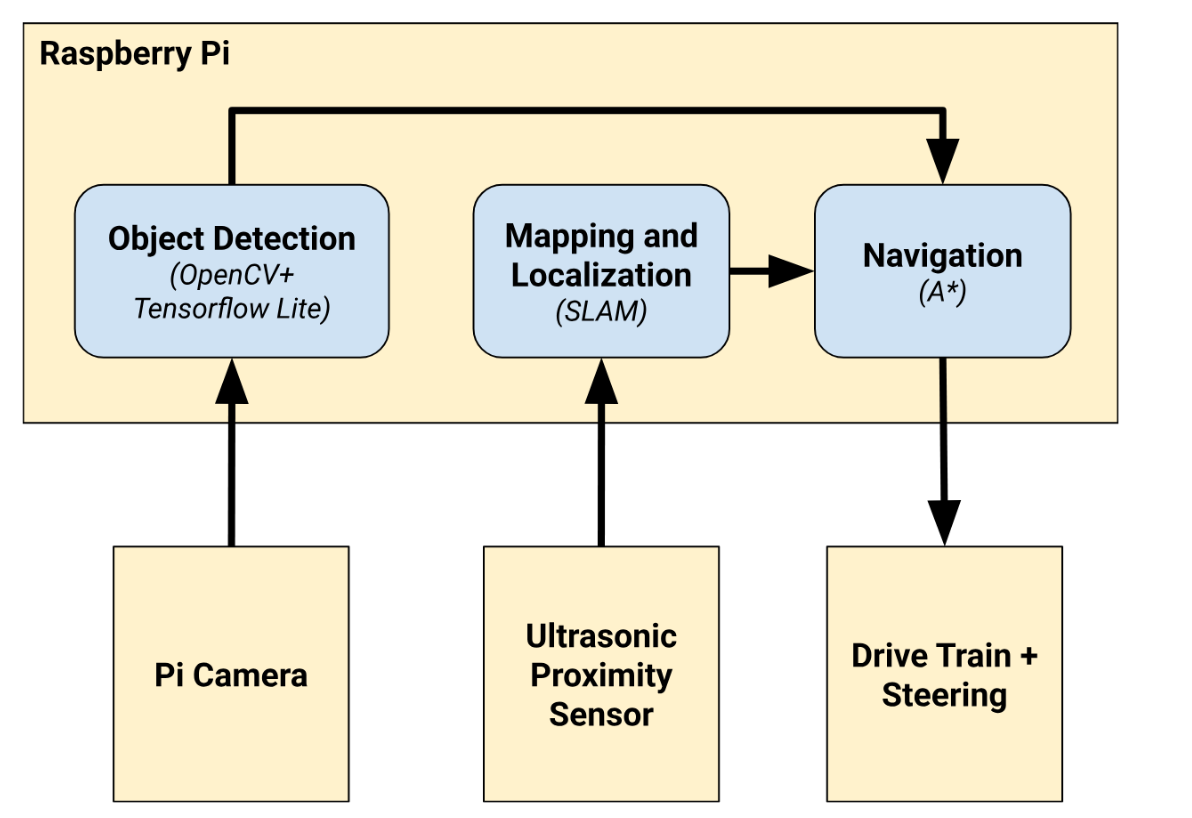
Built an end-to-end autonomy stack on an embedded vehicle, closing the loop from local sensing and online map construction through goal-directed planning, visual recognition, and motor control while exposing live vehicle telemetry over wireless links.
- SLAM & Localization: Implemented SLAM by converting servo-scanned ultrasonic ranges into a continuously updated 2D occupancy grid and tracking vehicle pose through velocity-based dead reckoning, periodically rescanning as new regions became observable.
- Online Planning & Safety: Implemented A* search with obstacle inflation for vehicle clearance and repeated replanning toward coordinate goals, combining the global route with a reactive proximity override for newly observed and dynamic obstacles.
- Edge Visual Autonomy: Integrated an embedded camera with OpenCV and quantized TensorFlow Lite inference for traffic-sign and object recognition, coupling semantic detections to behaviors such as stopping for signs or pedestrians before resuming the planned route.
- Vehicle Telemetry & Control: Built bidirectional Bluetooth control and telemetry plus a Wi-Fi REST service and Electron interface for remote actuation, sensor monitoring, and vehicle-state visualization.
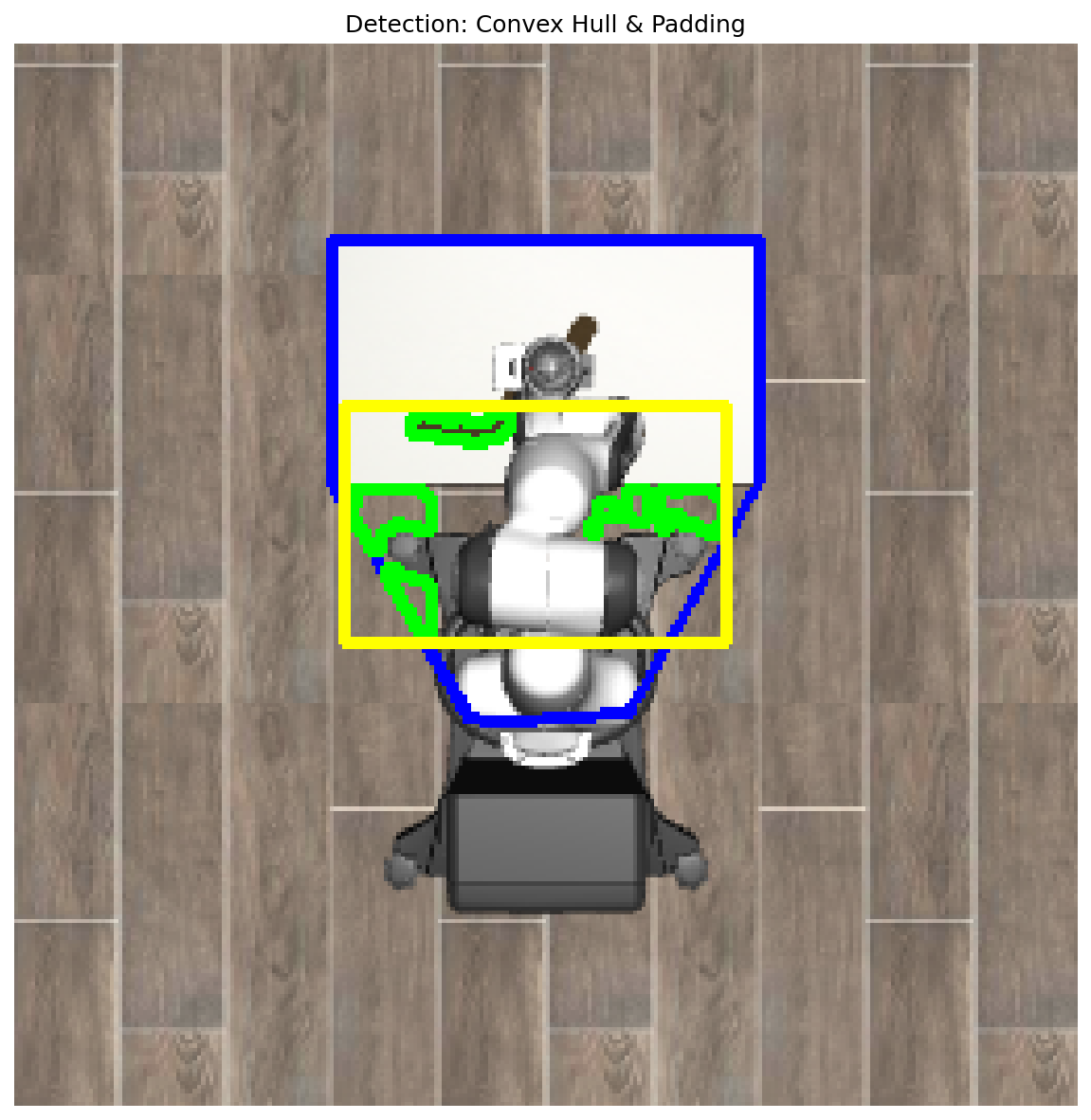
Built complementary geometric, learned, and hybrid manipulation systems in robosuite: an RGB-D cube-stacking pipeline, state-based and ResNet18 imitation policies, and a Simplex wiping controller combining reactive perception with behavioral-cloning fallback.
- Geometric Manipulation: Built an 8-joint URDF and PD waypoint controller with SLERP orientation, then implemented RGB-D segmentation, metric-depth deprojection, world-frame point clouds, adaptive clustering, clearance-aware grasp selection, and staged green–red–green stacking without simulator poses entering the control loop.
- Imitation Learning: Trained state-based MLP and ResNet18 visuomotor policies on 3,942 state transitions and 5,336 labeled image-action frames, reaching approximately 89% and 95% validation action accuracy, respectively; implemented interactive DAgger collection for correcting policy-induced failure states.
- Simplex Hybrid Control: Combined reactive dirt detection and boustrophedon planning with behavioral-cloning fallback, achieving 97.6% ± 2.0% coverage and 100% success across five trials versus 40% vision-only and 20% BC-only.
Computer Vision
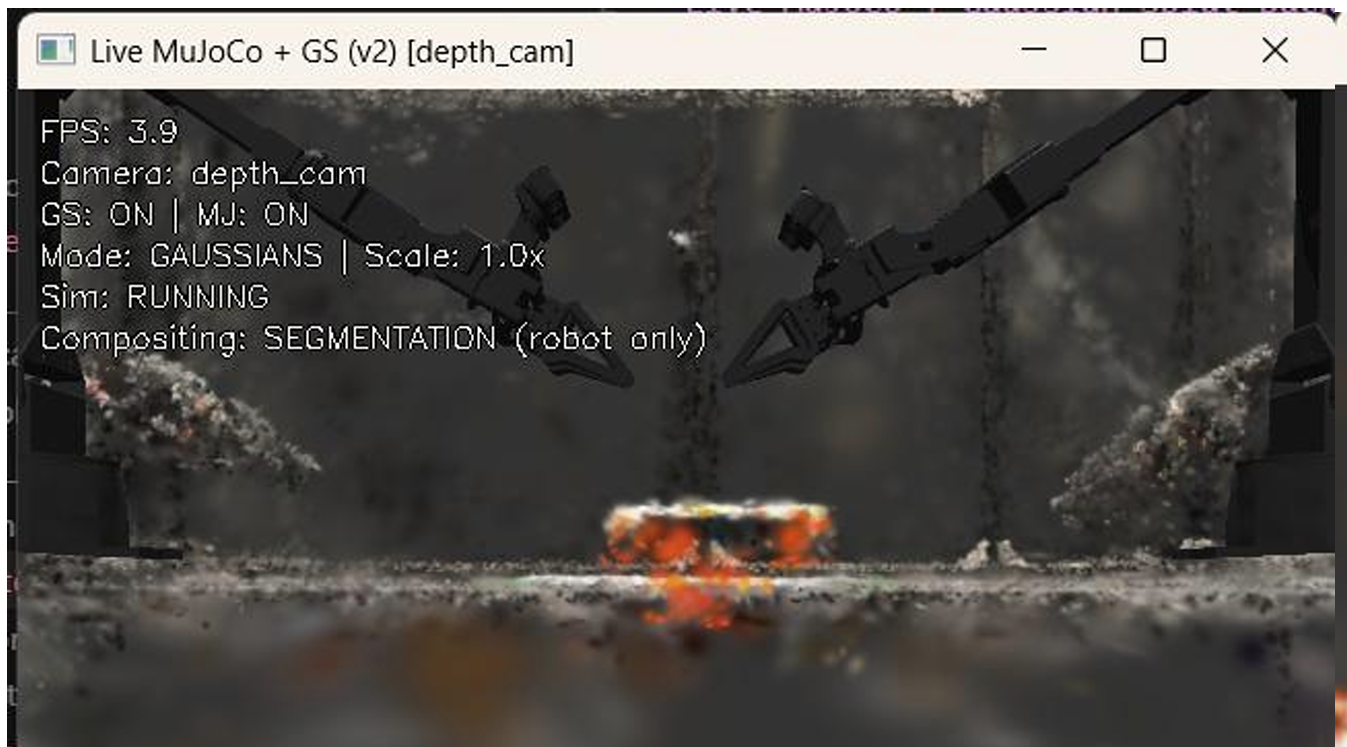
Contributors: Nippun Sabharwal, Shivansh Patel
Aligned a photorealistic 3D Gaussian Splat of a real ALOHA workspace with its MuJoCo twin, creating a shared coordinate frame for physically grounded rendering, simulation, and policy-facing multi-camera observations.
- 3DGS–Physics Alignment: ICP registration pipeline aligning a real-world Gaussian Splat capture (iPhone LiDAR + COLMAP) of an ALOHA bimanual setup with its MuJoCo twin, achieving 7.0 mm RMSE via point-to-plane ICP with Tukey robust loss and adaptive voxel downsampling.
- Real-Time Composite Rendering: MuJoCo robot foreground (segmentation mask) + custom NumPy Gaussian rasterizer background at 30–60 FPS across 7+ viewpoints including wrist cameras.
- Policy-Ready API: Observation interface matching the real ALOHA multi-camera topology, outputting dicts compatible with LeRobot and OpenPI policy servers for direct sim-to-real transfer.
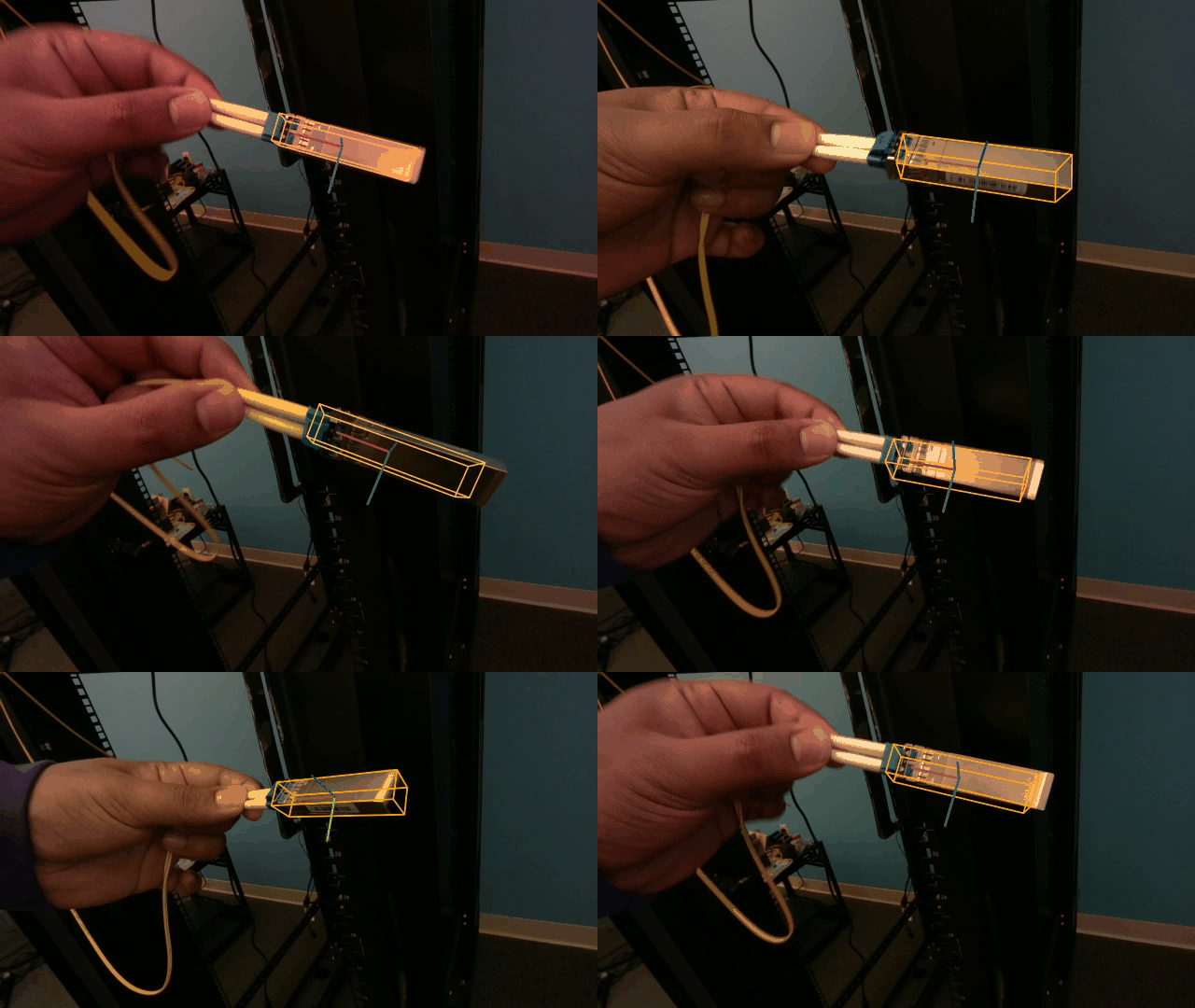
Built a markerless 6-DoF plug-pose tracking pipeline from Intel RealSense RGB-D recordings and a CAD model, combining SAM2 segmentation, masked-depth point clouds, multiscale ICP, and calibrated pose-frame correction.
- Perception Pipeline: Separated SAM2-based 2D object tracking from metric 3D estimation using depth deprojection, STL registration, and multiscale ICP.
- Held-Out Evaluation: Calibrated the pose-frame correction on 60% of ArUco-visible frames and evaluated on the held-out 40%, reaching 4.40 mm mean translation error and 11.98° mean rotation error.
- Diagnostics: Produced per-frame overlays, pose trajectories, and failure analysis for partial geometry, mask contamination, symmetry, and tracking drift.
At NCSA and CSL, developed Wave2Plane as part of a broader investigation into physics-informed recovery of scenes degraded by refractive turbulence. The framework combines simulator-grounded supervision, spatiotemporal geometry estimation, and multi-frame optimization to reconstruct planar underwater scenes without paired real-world ground truth.
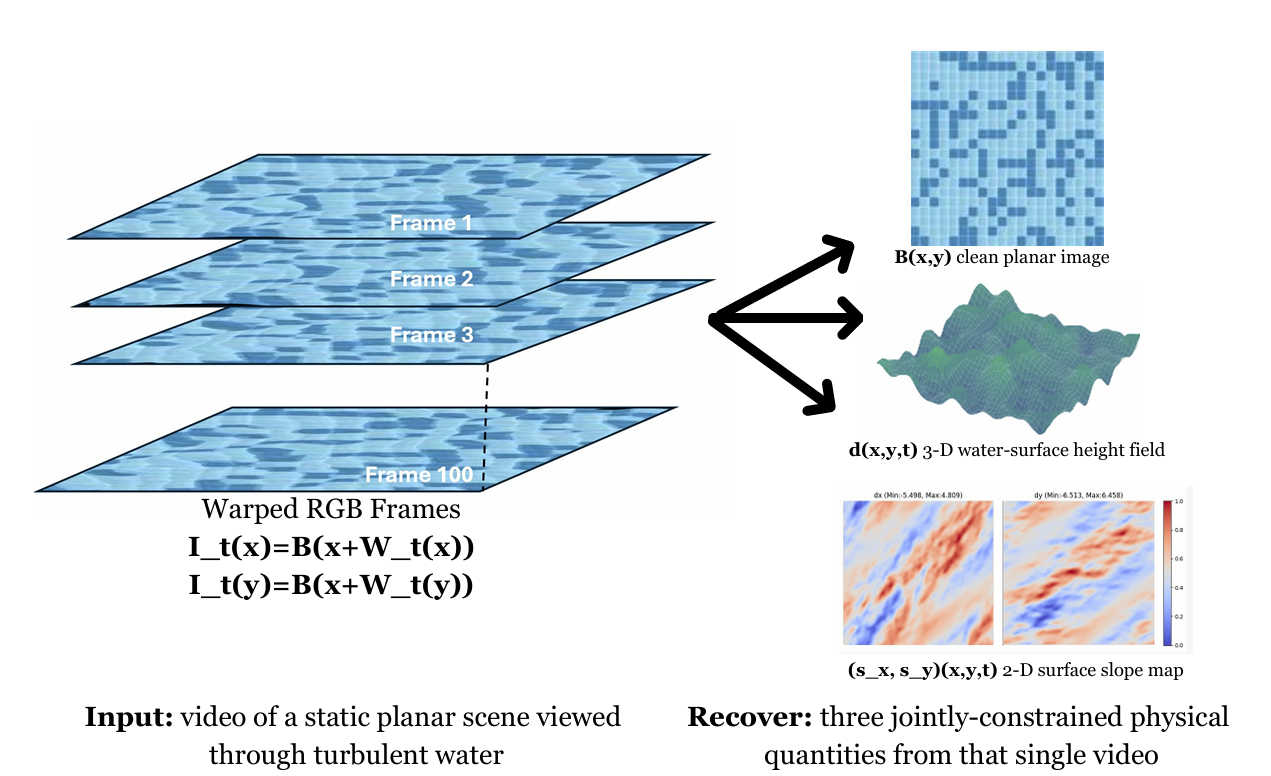
- Physics-Grounded Simulation: Built a spectral wave simulator with 3D surface geometry, Snell-law ray tracing, and subpixel warping to generate clean-image, slope, and optical-warp supervision.
- Monocular 3D Geometry Estimation: Trained multi-head 3D CNN and ViT models to infer per-pixel surface orientation, refractive displacement, and flatness from a single RGB video, achieving under 0.5° slope MAE.
- Multi-Frame Scene Reconstruction: Reprojected and fused complementary observations into a shared planar coordinate frame, recovering clean scene appearance at up to 32 dB PSNR without stereo or depth sensors.
- Global Geometric Optimization: Enforced cross-frame consistency through splat-buffer and clean-image reprojection objectives, improving reconstruction by an additional 2–3 dB without clean test-time targets.
Systems
Contributors: Nippun Sabharwal, Shreyanka Sinha, Sankalp Yamsani, Noboru Myers
Engineered an intuitive VR teleoperation system that enables precise, real-time remote robot control by translating head movements into robot actions and providing immersive 3D visual feedback for enhanced depth perception.
- Real-Time Head-Driven Control: Captured 3-DOF head-pose at 60 Hz from an Oculus headset via ROS, translating movements into joint commands for a multi-DOF robotic neck. This facilitates smooth, natural robot motion through imitation learning.
- Immersive 3D Visual Feedback: Integrated a stereo RGBD camera, streaming dual-view video into the Oculus, completing a closed loop where the headset user sees the robot's environment and can repeatedly perform actions with immediate feedback, providing operators with crucial depth perception for fine manipulation tasks.
- Modular & Extensible Architecture: Designed a Unity–ROS–Dynamixel workflow with configurable DOF settings, ensuring adaptability to various robot platforms and paving the way for future full-body telemanipulation. Implemented ROS dampening filters and H.264/H.265 video compression, achieving 60 Hz command updates with 45–60 ms round-trip delay and sub-degree motion accuracy.
- Demonstrated Results: Successfully executed remote folding and assembly tasks over a 3,000-mile network. Trained imitation learning policies for long-horizon tasks (sorting, insertion, folding), cutting fine manipulation time by ~30%, establishing a robust foundation for scalable imitation-learning data collection.
STL credit: OpenTeleVision
Implemented shape-general 2D convolution from scratch in CUDA, progressing from direct and implicit-GEMM FP32 kernels to FP16/BF16 Tensor Core execution with FP32 accumulation. Built a scalar CPU oracle and regression suite for arbitrary strides and non-aligned tensor shapes, reaching 428 GFLOP/s on an RTX 3050.
- Kernel Design: Implemented direct NCHW convolution with constant-memory filter reuse and a 16 × 16 shared-memory implicit GEMM, then built four-warp WMMA kernels with genuine FP16/BF16 storage, shared weight tiles, tail-safe indexing, and FP32 accumulation.
- Benchmarking & Correctness: Built deterministic shape sweeps with CUDA-event, end-to-end, and five-trial median timing. Tensor Core kernels reached 428.4 GFLOP/s, 1.89× direct CUDA, and over 350× the single-thread CPU oracle; maximum absolute error remained below 1.2 × 10⁻³ for FP16 and 7.9 × 10⁻³ for BF16 across the regression suite.
- Optimization Study: Replaced ineffective in-kernel FP16 conversion with true 16-bit tensor storage and Tensor Core execution, compared FP32/FP16/BF16 accuracy–throughput tradeoffs, and kept mixed precision as an explicit dispatch choice rather than silently changing numerical behavior.
Research with Prof. Bin Hu · NeurIPS 2025
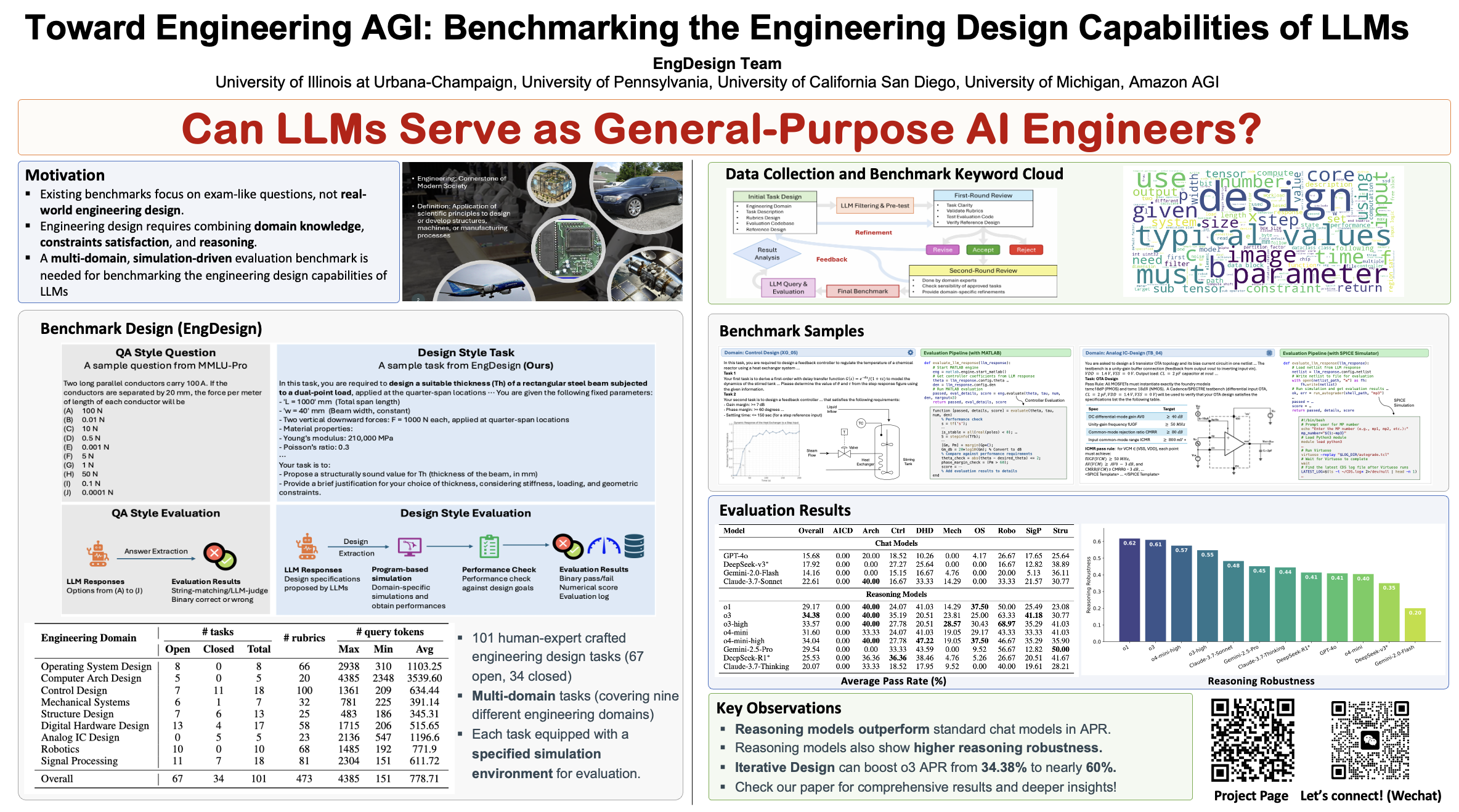
Co-developed EngDesign, a multi-domain benchmark for evaluating whether frontier LLMs can produce executable engineering designs rather than answer static technical questions. Contributed the digital-hardware evaluation pipeline, using simulation and testbench feedback to measure functional correctness and support iterative design refinement.
- Executable Benchmark Design: Helped formulate constraint-driven engineering tasks evaluated through domain-specific simulators, shifting assessment from answer matching to whether generated artifacts satisfy real design requirements.
- Hardware Evaluation: Built hierarchical SystemVerilog tasks and automated graders that compiled and simulated generated modules against testbenches, exposing functional errors that text-only evaluation could not detect.
- Closed-Loop Refinement: Integrated simulation and synthesis tools into an agentic verification loop that returned structured failure feedback for iterative correction and systematic comparison of frontier models.
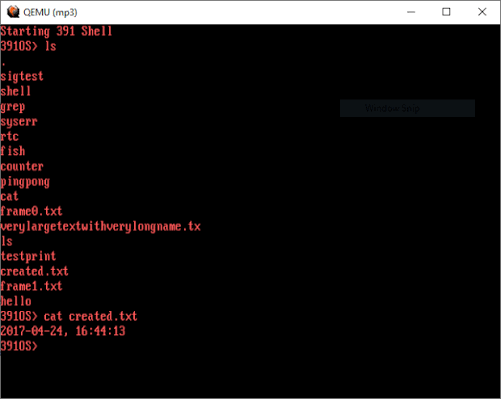
Developed a full UNIX-style operating system kernel and robust journaling filesystem from scratch for the RISC-V architecture.
- Kernel: Implemented core OS functionalities including a bootloader, trap handling, Sv39 virtual memory with demand paging, and process abstraction. Supports essential user-mode syscalls (open, close, read, write, ioctl, exec, fork, wait, usleep, fscreate, fsdelete). Created cooperative and preemptive threading models using condition variables and timer (mtime) interrupts.
- Custom Filesystem + Block Cache: Engineered a block-based filesystem with a write-ahead journal for metadata consistency and crash recovery. Supports create, read, write, delete, flush, and multi-level indirection. Mountable via VirtIO block device or in-memory "memio" for rapid testing. Implemented a write-back cache with configurable associativity, reducing I/O latency by ~45% while ensuring data consistency through the journaling mechanism.
- Device Drivers & MMIO: Developed drivers for UART (polling & interrupt-driven), Real-Time Clock (RTC), Platform-Level Interrupt Controller (PLIC), VirtIO block & RNG devices (with custom ISR integration), and GPIO, SPI interfaces for embedded peripherals.
- Games! Built a unified I/O interface to load and execute ELF binaries (Star Trek, Doom, Rogue, Zork) on QEMU RISC-V, validated by automated tests for correct loading, execution, and system-call handling.
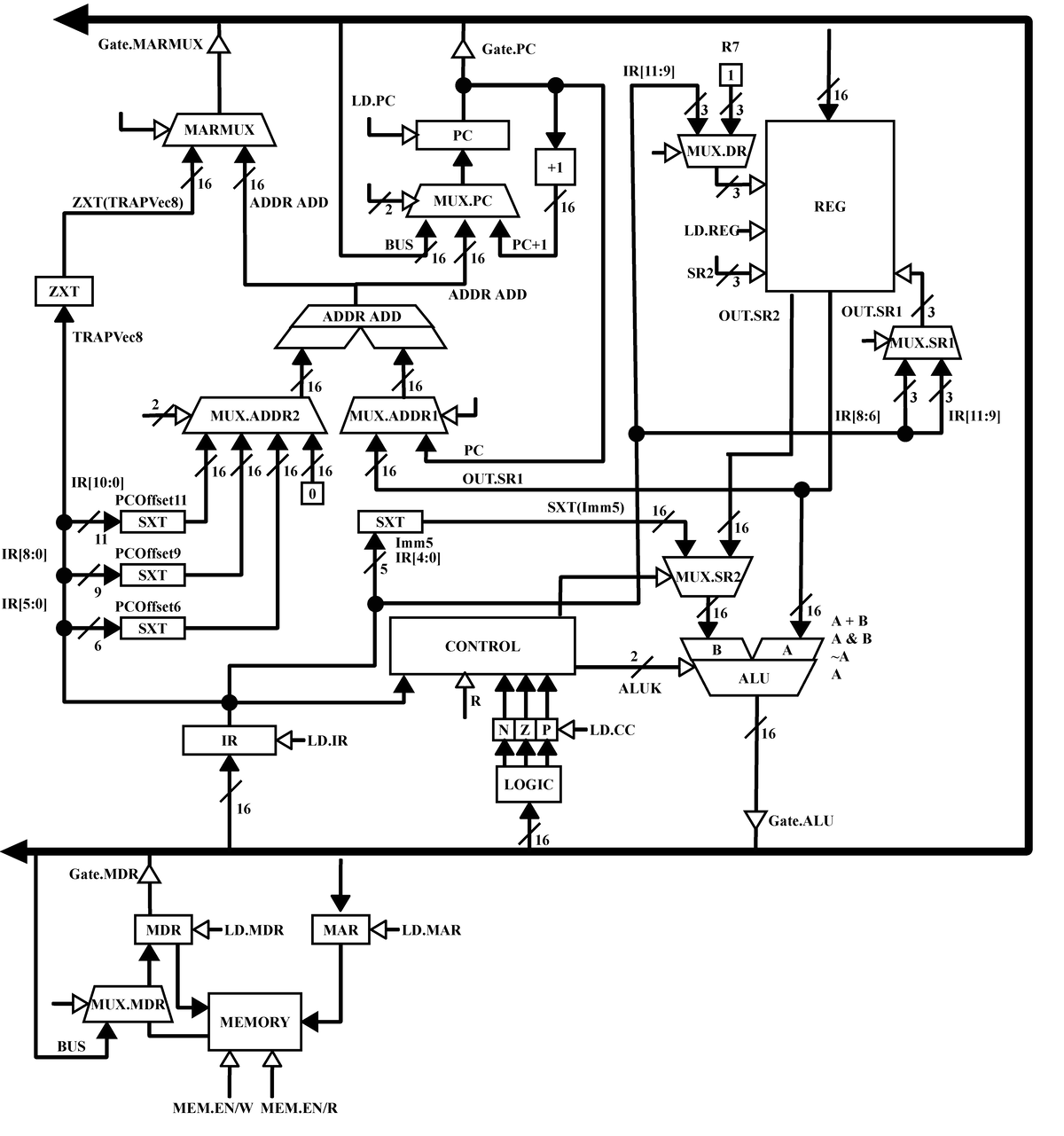
Designed and implemented a 16-bit CPU based on a reduced instruction set, x86-inspired ISA in SystemVerilog, end-to-end from ISA specification through FPGA verification.
- ISA & Pipeline: 16-bit processor with Program Counter, Instruction Register, general-purpose registers, ALU, and a 3-stage fetch–decode–execute pipeline supporting ADD, AND, NOT, BR, JMP, JSR, LDR, STR, and PAUSE. FSM control unit sequences memory access, ALU operations, and I/O interactions via a custom
cpu_to_iobridge interfacing with on-board switches and hex displays. - Memory-Mapped I/O & BRAM: Mapped UART, switches, and seven-segment displays into the CPU's address space using on-chip Spartan-7 Block RAM, handling read/write timing without an external "ready" signal.
- Graphics Controller: Developed an IP-core-based HDMI graphics controller for 80×30 character text rendering over AXI4 on Vivado IP Integrator. Implemented monochrome and color text output using VRAM and font ROM, supporting inverse text and palette-based coloring.
- FPGA Verified: Synthesized and achieved timing closure in Vivado, deploying and verifying stable operation at 50 MHz on a Xilinx Spartan-7 board.
Earlier Projects
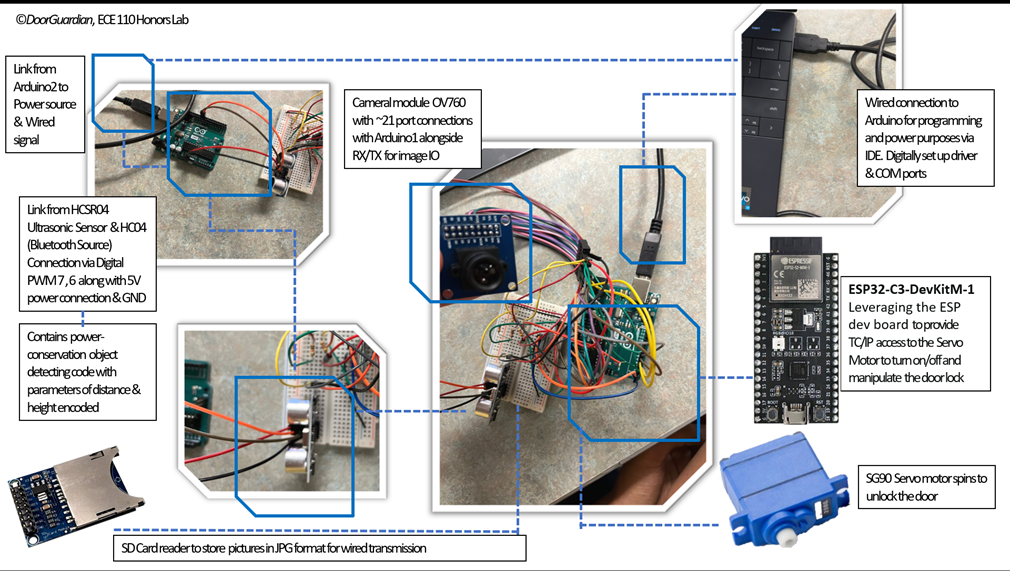
Contributors: Nippun Sabharwal, Vayun Gupta, Siddarth Natarajan
Developed an autonomous security system to modernize access control, replacing traditional key/card-based systems with sensor-triggered visual verification and remote actuation.
- Problem: Campus and home access relying on physical cards or keys creates delays, extra costs, and accessibility barriers.
- Solution: An ultrasonic sensor (HC-SR04) detects approaching individuals, triggering an Arduino UNO and OV7670 camera. The captured image streams via UART → PC → Telegram bot. The owner sends "door open" / "door close" over Telegram, and an ESP32 actuates SG90 servo motors to lock or unlock.
- Tech Stack: HC-SR04 ultrasonic sensor (50 cm trigger range, power-saving standby), OV7670 camera over UART, Arduino UNO for coordination, ESP32 for Wi-Fi and Telegram API, SG90 servos for actuation, Make.com for workflow automation.
- Features: Live video feed for verification, automated entry/exit logs, updatable face database, upgradable firmware. Real-world applications include keyless Airbnb access, ID-free campus entry, and improved accessibility.
My first project! Built and scaled a Harry Potter fan community to 12,500+ registered users and 4,000+ social media followers. Led and coordinated a team of 30 volunteers to develop quizzes, discussion forums, and engaging content, fostering a highly active online platform.
Industry Experience
Built long-horizon evaluation infrastructure for camera/ADAS and vehicle-hardware validation, transforming multi-signal telemetry into reproducible campaigns, automated robustness verdicts, and traceable failure diagnoses.
- Validation Platform: Made fragmented ECU-specific workflows hardware-agnostic through extensible schema and payload adapters, versioned signal specifications, GitLab CI/CD, and automated pass/warn/fail verdicts.
- Long-Horizon Telemetry: Built 1 Hz logging, ingestion, and temporal evaluation across three hardware families and 18–21 units, supporting 300+ hour campaigns and recurring 20-hour stress tests.
- Failure Attribution: Correlated camera/ADAS failures with CAN behavior, power transitions, adjacent cycles, and related subsystems; paired deterministic diagnostics with grounded agent-assisted triage to reduce initial investigation to under 10 minutes.
- Built an intelligent agent with natural language interface using RAG and LangGraph with MCP framework, querying millions of rows of pharma data in under 10 s.
- Designed secure, highly available AWS stack (ECS, ALB, WAF, CloudWatch) delivering 99.9% uptime, scaling to 50+ concurrent users.
- Led cross-functional discovery, built MVP independently, then collaborated with Mexico Data Science team for company-wide rollout.
- Developed and optimized RESTful & GraphQL APIs, improving data retrieval speed by 40% and scalability for high-traffic usage.
- Refined CI/CD pipelines using Jenkins and Docker, reducing deployment time by 50%.
Skills
Education
- Honors: Samsung Engineering Scholarship, Illinois Outstanding Scholarship, Illinois Engineering Achievement Scholarship, Compall Family Scholarship
- Coursework: Deep Learning, Parallel Programming, Computer Architecture, Data Structures, Algorithms